

You don’t notice most trade show stands. Yours might be one of them.
Walk into any B2B exhibition and you’ll see it straight away. Big stands, clean branding, screens looping the same video. Teams ready at the front. Everything looks polished. And yet, very few stands are actually remembered afterwards.
That’s the uncomfortable part. Because most brands didn’t come to simply “be there”. They came to make an impact.
Where it goes wrong
It usually starts with a strong story. A solid product, smart engineering, years of development. The kind of work you’re proud of.
Then it has to be translated to a trade show. And that’s where it gets difficult. Because how do you show something that is:
- too technical to explain quickly
- too big to physically bring
- or simply invisible to the eye
The result is often the same. A stand, some visuals, maybe an animation. And a team explaining it again and again. Not because it’s wrong, but because there simply wasn’t a better way to show it.
The shift: from explaining to letting people experience
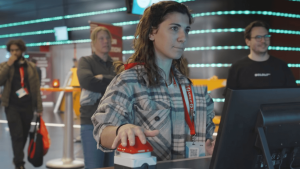
Some stands only start to make sense once someone walks you through them. Others don’t need that. People step in, interact for a moment, and it clicks as they go.
Immersive experiences work in that second category. They don’t simplify complexity by explaining it. They make it navigable through interaction.
What that looks like in practice
i4F
With i4F, the innovation sits beneath the surface. Advanced flooring technologies and patented systems that are powerful, but not immediately visible.
Instead of explaining how it works, we made it tangible. An interactive environment where visitors could explore the technology layer by layer and understand the system in moments.
TNA Solutions
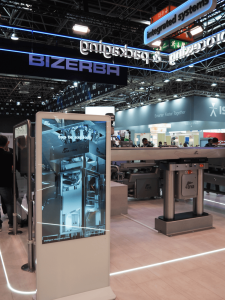
TNA Solutions builds full-scale food processing lines. Impressive, but impossible to bring to a trade show in physical form.
Instead of reducing the story to static visuals, we created an interactive experience around it. High-end visualisations, touchscreen interactions and modular kiosks allowed visitors to explore the different solutions in a clear and intuitive way.
Not a simulation of a machine, but an experience of the system.
Why this matters more than ever
Trade shows haven’t become less crowded. If anything, there’s more noise, more visuals and more competition for attention.
So the bar is no longer visibility. It’s comprehension. And more importantly: memory after the event. That doesn’t come from explanation alone. It happens when people experience what you do.
A simple check for your next exhibition
Ask yourself this before you start designing your stand: Are we asking visitors to understand us or are we making it easy for them to feel it straight away? That one shift changes everything.
From how long people stay to what they remember and to whether they come back to you after the event
You don’t need to shout louder than the stand next to you, you need to give people a reason to pause. To look, to try, to get it, without effort. That’s where the difference is made.
Curious how that could work for your next trade show? Let’s figure it out together.