
AR you ready? The future of marketing and e-commerce with Augmented Reality.
Augmented Reality (AR) is no longer just a futuristic technology for sci-fi movies. Instead its an essential tool for marketers and e-commerce managers. It is a technology that adds a digital layer to the physical world. For example, you see the world around you through your phone’s camera, with digital elements added to your environment. In this way, AR creates an immersive and interactive experience for users. It looks like the digital elements added to the physical environment are real. As a result, AR offers experiences that far surpass traditional marketing methods.
This blog will give you examples of the various AR opportunities and applications. From product previews, face filters instructional AR to creative concept elaborations.
Product previews
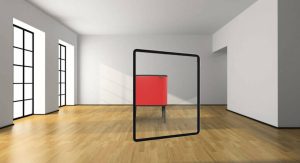
AR enables potential customers in a very simple way to be able to view products already in their own environment. Equally at a true scale and with colour fidelity. As explained, the principle of AR is a layer over real reality. Let’s take Brabantia trash cans as an example. Users watch their home environment through the camera on their phone or tablet, in which they can place a lifelike trash can. With this campaign, questions such as; “Does this trash can fit here?” and “How does the colour fit with my wallpaper?”. These questions could be easily answered with this digital solution. AR is very accessible because anyone with a phone or tablet can easily use an AR application. In e-commerce, this really makes a difference, we see people buying more faster and returning less.
Face filters
Where it once started with simple face filters on Snapchat, the possibilities are now endless. Makeup previewing on your own face is a combined form of AR, combining product previewing and face filters to show products on the user’s face. This way, someone can already try out the entire lipstick collection at home. This is also ideal for offering, for example, a collection of (sun)glasses or caps in an interesting way online. Being able to try a product on your own face in this way greatly lowers the barrier to order.
In addition to these kinds of realistic face filters, there are also abstract filters we know from Snapchat and Instagram. Face filters form an interactive experience that can be easily shared on social media and, by their surprising nature, create more engagement with your brand. For example, as a brand, you can create brand filters appropriate to your campaign, allowing users to take a picture with the 3D version of your logo.
Instructional AR
This can be used to instruct users or customers about a product or service. Especially for complex products such as machines or software, AR can be helpful. By offering step-by-step instruction with interactive visuals, users will understand the instruction better and move through it faster, after all, people are visually oriented. It also allows explanations to be provided in an interesting way. In our campaign for Dutch Pro (a company specializing in garden and greenhouse products), we designed scannable labels for all their products. On the contrary, when these labels were scanned, AR transformed the label into a visual animation that explained exactly what this product is for and what it is used for.

Creative concepts
The possibilities with AR are endless, and countless other applications can be imagined. All kinds of concepts can be worked out in a creative and intriguing way with AR. Take, for example, the bus shelter poster we designed for the Rotterdam Philharmonic Orchestra. This abri contained a QR code that after scanning with a phone, brought the poster to life with images and sound. Or our AR models for Numedico, who were looking for an appropriate way to present their new, innovative hypodermic needles. An AR animation detailed the method of operation of this syringe. Or Kohler, who was looking for a lightweight way to take their latest generators everywhere. With AR, you just put those generators down in space. You can look at them from all sides and possibly click parts to get more information about that element. Following you can take the generators apart to get a better look at the technology on the inside.
ROI or AR
AR can achieve a significant return on investment. Due to its unusual and interactive nature, AR quickly attracts users’ attention. People are becoming handier with it and will increasingly expect these applications from their favourite stores as well. By being able to view an accurate presentation of a product at home, customers are more likely to make a purchase. Several studies show an increase in sales of sometimes as much as 20% to 40%. Also, the number of returns is significantly reduced by up to 40%, because people know what to expect, so AR also aids sustainability. AR also removes the need for physical prototypes or product samples, which can reduce waste and costs. It is also of course accessible anywhere in the world, this increases your reach.
In conclusion, AR filters are an addition to any campaign by brands that want to move with the times. Instructions and explanations have never been so clear and interesting as when you see something come to life before your eyes. AR has become indispensable due to its fun, powerful and educational nature. So, embrace AR and take your next marketing campaign to the next level!